


How to Avoid Signal Collisions and Ensure Identification Accuracy in Dense Multi-Tag Reading Scenarios with RFID 4-Port Modules
Release Time : 2026-02-18
In high-frequency application environments such as warehousing and logistics, smart manufacturing, and retail inventory management, UHF RFID systems often face the challenge of "dense tag" scenarios where hundreds or even thousands of electronic tags simultaneously enter the reading/writing area. Improper handling can easily lead to signal collisions, missed reads, or misreads, severely impacting system reliability. RFID 4-port modules not only expand coverage but also significantly improve identification efficiency and accuracy in dense tag scenarios through advanced anti-collision mechanisms and intelligent scheduling algorithms.
1. High-Efficiency Anti-Collision Algorithm Based on EPC Gen2 Protocol
The RFID 4-port module standard employs an anti-collision mechanism combining "time slot ALOHA" and "dynamic Q-value adjustment." When multiple tags respond to reader queries simultaneously, the system divides the time into several time slots, requiring tags to randomly select a time slot to transmit information, thereby reducing the probability of collisions. More importantly, the module's built-in proprietary baseband processor can monitor tag response density in real time and dynamically optimize Q parameters—increasing the Q value to distribute the response when tags are dense and decreasing the Q value to speed up recognition when tags are sparse. This adaptive strategy enables a single channel to stably identify more than 200 tags per second, significantly reducing latency caused by repeated polling.
2. Four-Port Time-Division Multiplexing and Spatial Isolation Collaboration
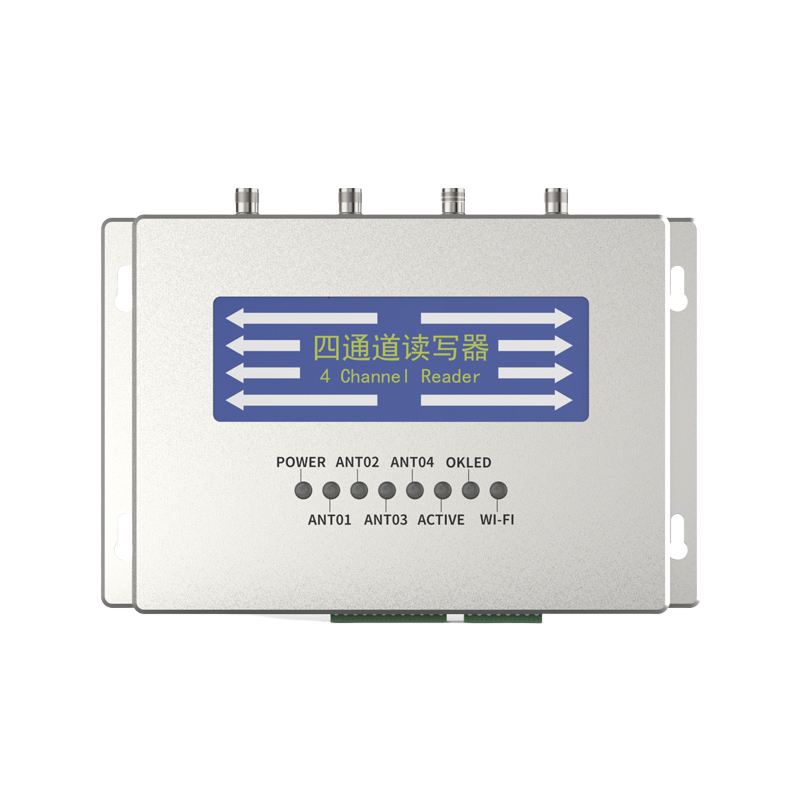
The 4-port design not only means connecting four antennas for greater coverage, but more importantly, it supports intelligent antenna polling and spatial diversity. The module switches between different ports in microseconds via a high-speed RF switch, achieving "time-division and zone-based" reading: each antenna covers an independent area, avoiding global conflicts caused by the superposition of tag signals from multiple areas. Simultaneously, some high-end configurations support "full-duplex polling" or "overlapping scan" modes—while the main antenna is reading, adjacent antennas are pre-activated to prepare for the next area, improving overall throughput. Furthermore, by rationally arranging the antenna polarization direction and installation angle, spatial isolation can be used to further reduce cross-channel interference, ensuring signal purity at each port.
3. High-Sensitivity Reception and Digital Signal Enhancement Technology
In dense environments, weak-signal tags are easily masked by strong signals. This module employs a low-noise amplifier and a high dynamic range ADC, achieving a reception sensitivity below -85 dBm, effectively capturing weak echoes from distant or obscured tags. Simultaneously, its self-developed digital signal processing engine filters, deconvolves, and equalizes aliased signals, separating overlapping return data; combined with forward error correction coding, it can accurately restore tag IDs even with partially damaged data, keeping the bit error rate below 10⁻⁶.
4. Intelligent Scheduling and Edge Computing Optimization
To cope with extremely dense environments, the module supports "tag group management" and "priority identification" strategies. For example, by using preset filtering rules, it focuses only on target tag groups, skipping irrelevant tags; or it enables multiple verification mechanisms for high-value items to ensure zero missed reads. Furthermore, some models integrate edge computing capabilities, enabling preliminary data aggregation and deduplication at the module level, reducing the load on the host computer and improving system response speed.
In summary, the RFID 4-port module effectively solves the signal conflict problem in dense multi-tag reading through a four-pronged mechanism: adaptive anti-collision at the protocol layer, intelligent multi-port scheduling at the hardware layer, high-sensitivity reception at the physical layer, and edge optimization at the system layer. It not only ensures an identification accuracy rate of over 99.9%, but also significantly improves the tag processing capacity per unit time, providing a solid technical foundation for high-efficiency and high-reliability IoT applications.
1. High-Efficiency Anti-Collision Algorithm Based on EPC Gen2 Protocol
The RFID 4-port module standard employs an anti-collision mechanism combining "time slot ALOHA" and "dynamic Q-value adjustment." When multiple tags respond to reader queries simultaneously, the system divides the time into several time slots, requiring tags to randomly select a time slot to transmit information, thereby reducing the probability of collisions. More importantly, the module's built-in proprietary baseband processor can monitor tag response density in real time and dynamically optimize Q parameters—increasing the Q value to distribute the response when tags are dense and decreasing the Q value to speed up recognition when tags are sparse. This adaptive strategy enables a single channel to stably identify more than 200 tags per second, significantly reducing latency caused by repeated polling.
2. Four-Port Time-Division Multiplexing and Spatial Isolation Collaboration
The 4-port design not only means connecting four antennas for greater coverage, but more importantly, it supports intelligent antenna polling and spatial diversity. The module switches between different ports in microseconds via a high-speed RF switch, achieving "time-division and zone-based" reading: each antenna covers an independent area, avoiding global conflicts caused by the superposition of tag signals from multiple areas. Simultaneously, some high-end configurations support "full-duplex polling" or "overlapping scan" modes—while the main antenna is reading, adjacent antennas are pre-activated to prepare for the next area, improving overall throughput. Furthermore, by rationally arranging the antenna polarization direction and installation angle, spatial isolation can be used to further reduce cross-channel interference, ensuring signal purity at each port.
3. High-Sensitivity Reception and Digital Signal Enhancement Technology
In dense environments, weak-signal tags are easily masked by strong signals. This module employs a low-noise amplifier and a high dynamic range ADC, achieving a reception sensitivity below -85 dBm, effectively capturing weak echoes from distant or obscured tags. Simultaneously, its self-developed digital signal processing engine filters, deconvolves, and equalizes aliased signals, separating overlapping return data; combined with forward error correction coding, it can accurately restore tag IDs even with partially damaged data, keeping the bit error rate below 10⁻⁶.
4. Intelligent Scheduling and Edge Computing Optimization
To cope with extremely dense environments, the module supports "tag group management" and "priority identification" strategies. For example, by using preset filtering rules, it focuses only on target tag groups, skipping irrelevant tags; or it enables multiple verification mechanisms for high-value items to ensure zero missed reads. Furthermore, some models integrate edge computing capabilities, enabling preliminary data aggregation and deduplication at the module level, reducing the load on the host computer and improving system response speed.
In summary, the RFID 4-port module effectively solves the signal conflict problem in dense multi-tag reading through a four-pronged mechanism: adaptive anti-collision at the protocol layer, intelligent multi-port scheduling at the hardware layer, high-sensitivity reception at the physical layer, and edge optimization at the system layer. It not only ensures an identification accuracy rate of over 99.9%, but also significantly improves the tag processing capacity per unit time, providing a solid technical foundation for high-efficiency and high-reliability IoT applications.