


How can an RFID Reader Module achieve efficient anti-collision and rapid identification in densely populated multi-tag environments?
Release Time : 2026-04-02
In applications such as warehousing and logistics, smart manufacturing, and retail inventory management, RFID systems often need to identify a large number of electronic tags in a short period of time. Especially in densely populated multi-tag environments, signal collisions between tags can significantly affect identification efficiency and accuracy. Achieving efficient anti-collision and rapid identification in the RFID Reader Module is crucial for improving system performance.
1. Advanced Anti-Collision Algorithms are the Core Guarantee
When multiple tags respond simultaneously, without an effective anti-collision mechanism, the reader will struggle to distinguish individual tag signals. RFID Reader Modules typically employ anti-collision algorithms based on time slot allocation. By dividing communication time into multiple time slots, tags respond within different time windows, thus reducing signal overlap. Furthermore, a mechanism for dynamically adjusting the number of time slots can automatically optimize identification efficiency based on tag density changes, maintaining stable performance even in high-density scenarios.
2. Multi-Port Antenna Collaboration Improves Identification Efficiency
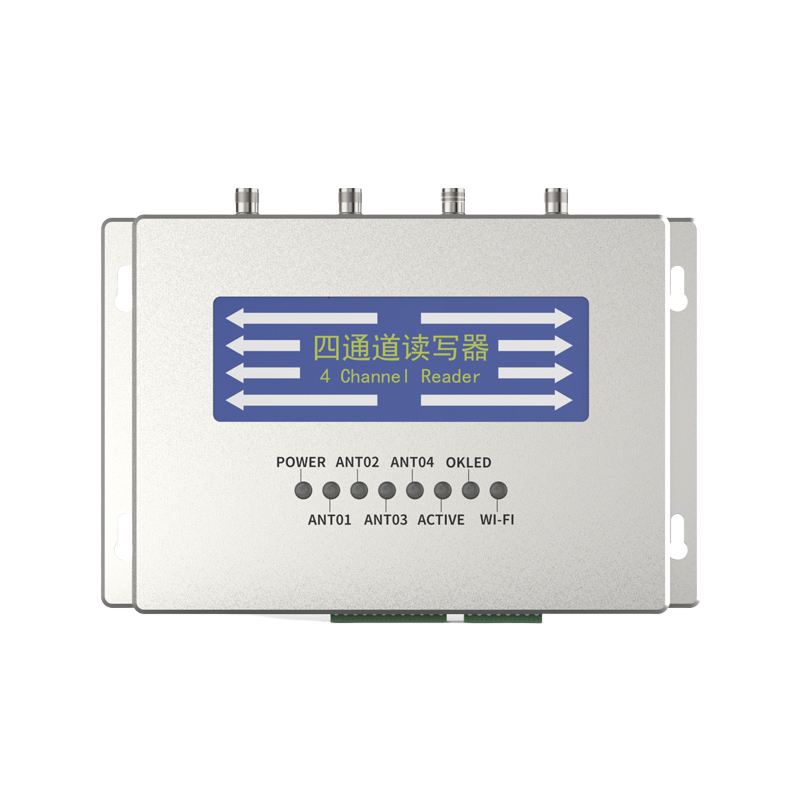
The four-port design allows the module to connect to multiple antennas, achieving multi-area coverage. In multi-tag environments, different antennas can operate in designated areas, reducing the number of tags competing within the same area and thus lowering the probability of collisions. Simultaneously, by using antenna polling or parallel operating modes, reading areas can be quickly switched, improving overall identification speed. Proper antenna placement also reduces blind spots, ensuring complete tag coverage.
3. RF Parameter Optimization Enhances Signal Resolution
In complex environments, proper RF parameter settings are crucial for identification performance. Adjusting transmit power, receive sensitivity, and operating frequency range optimizes signal propagation and reception. Appropriate power output control ensures reading distance while avoiding interference caused by excessively strong signals. Furthermore, optimizing modulation methods and encoding mechanisms helps improve signal anti-interference capabilities, enabling the reader to more accurately distinguish between different tag signals.
4. High-Speed Processing Capabilities Support Large-Scale Data Analysis
The RFID Reader Module is based on a high-performance platform and possesses strong data processing capabilities. When multiple tags are identified simultaneously, the module needs to quickly analyze and process large amounts of data. Through an efficient processor and optimized data caching mechanisms, data processing latency can be reduced, improving system response speed. Meanwhile, it supports batch data uploads and fast interface communication, facilitating real-time data management.
5. System Collaboration and Application Optimization Enhance Overall Performance
Besides hardware and algorithm optimization, system-level collaborative design is equally important. For example, by working with host computer software, functions such as tag filtering, priority setting, and data deduplication can be implemented, thereby reducing invalid reads and improving identification efficiency. Furthermore, adjusting reading strategies according to specific application scenarios, such as batch scanning or segmented area identification, can also effectively reduce collisions and improve overall system performance.
Achieving efficient anti-collision and rapid identification in multi-tag-dense environments requires the comprehensive application of advanced algorithms, multi-port collaboration, radio frequency optimization, and high-speed processing capabilities. Through systematic optimization, not only can identification efficiency be significantly improved, but stable and reliable data support can also be provided for various intelligent applications.
1. Advanced Anti-Collision Algorithms are the Core Guarantee
When multiple tags respond simultaneously, without an effective anti-collision mechanism, the reader will struggle to distinguish individual tag signals. RFID Reader Modules typically employ anti-collision algorithms based on time slot allocation. By dividing communication time into multiple time slots, tags respond within different time windows, thus reducing signal overlap. Furthermore, a mechanism for dynamically adjusting the number of time slots can automatically optimize identification efficiency based on tag density changes, maintaining stable performance even in high-density scenarios.
2. Multi-Port Antenna Collaboration Improves Identification Efficiency
The four-port design allows the module to connect to multiple antennas, achieving multi-area coverage. In multi-tag environments, different antennas can operate in designated areas, reducing the number of tags competing within the same area and thus lowering the probability of collisions. Simultaneously, by using antenna polling or parallel operating modes, reading areas can be quickly switched, improving overall identification speed. Proper antenna placement also reduces blind spots, ensuring complete tag coverage.
3. RF Parameter Optimization Enhances Signal Resolution
In complex environments, proper RF parameter settings are crucial for identification performance. Adjusting transmit power, receive sensitivity, and operating frequency range optimizes signal propagation and reception. Appropriate power output control ensures reading distance while avoiding interference caused by excessively strong signals. Furthermore, optimizing modulation methods and encoding mechanisms helps improve signal anti-interference capabilities, enabling the reader to more accurately distinguish between different tag signals.
4. High-Speed Processing Capabilities Support Large-Scale Data Analysis
The RFID Reader Module is based on a high-performance platform and possesses strong data processing capabilities. When multiple tags are identified simultaneously, the module needs to quickly analyze and process large amounts of data. Through an efficient processor and optimized data caching mechanisms, data processing latency can be reduced, improving system response speed. Meanwhile, it supports batch data uploads and fast interface communication, facilitating real-time data management.
5. System Collaboration and Application Optimization Enhance Overall Performance
Besides hardware and algorithm optimization, system-level collaborative design is equally important. For example, by working with host computer software, functions such as tag filtering, priority setting, and data deduplication can be implemented, thereby reducing invalid reads and improving identification efficiency. Furthermore, adjusting reading strategies according to specific application scenarios, such as batch scanning or segmented area identification, can also effectively reduce collisions and improve overall system performance.
Achieving efficient anti-collision and rapid identification in multi-tag-dense environments requires the comprehensive application of advanced algorithms, multi-port collaboration, radio frequency optimization, and high-speed processing capabilities. Through systematic optimization, not only can identification efficiency be significantly improved, but stable and reliable data support can also be provided for various intelligent applications.