


How does a 4-port UHF RFID reader achieve multi-area synchronous coverage and improve warehouse inventory efficiency through a four-channel TNC interface?
Release Time : 2026-01-09
In modern intelligent warehousing and logistics management, efficient, accurate, and real-time asset tracking capabilities have become a core competitive advantage for enterprises to reduce costs and increase efficiency. The 4-port UHF RFID reader—a professional-grade fixed device developed based on the TM series platform—is becoming a key sensing node in smart warehousing thanks to its four-channel TNC interface design, powerful multi-tag identification capabilities, long-distance reading performance, and high protection level. Its core advantage lies in: synchronously driving antennas in different areas through four independent radio frequency channels to achieve seamless coverage of complex spaces, upgrading traditional manual inventory counting by "point-by-point scanning" to automated operations of "instantaneous perception across the entire area," significantly improving warehouse inventory efficiency and data accuracy.
1. Four-channel TNC interface: Building a flexible and multi-directional radio frequency coverage network
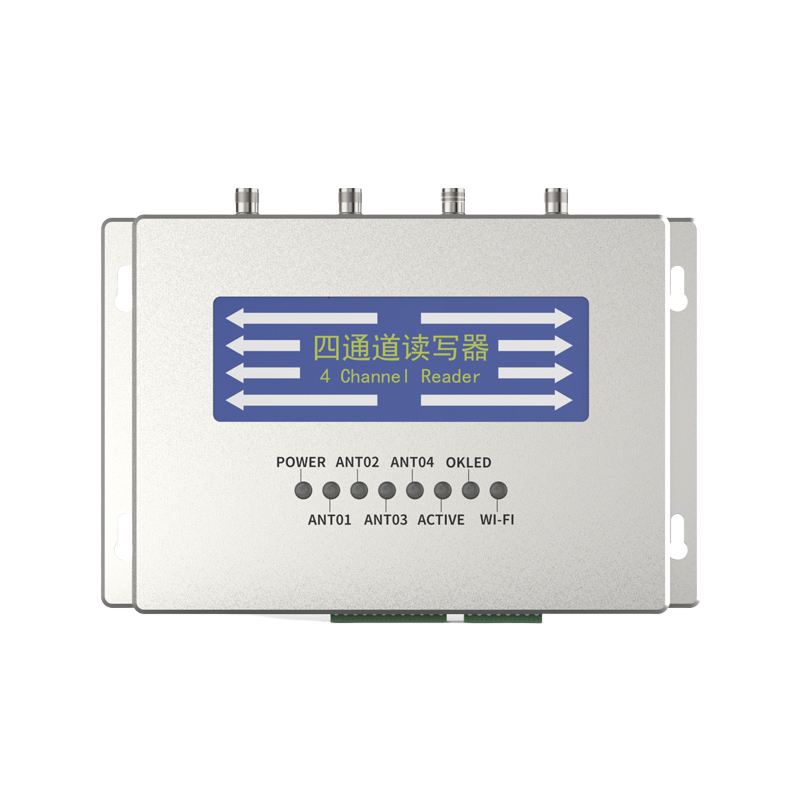
TNC is a high-performance radio frequency connector with good vibration resistance and high-frequency stability, suitable for industrial environments. The 4-port UHF RFID reader is equipped with four independent TNC output interfaces. Each channel can connect to a directional or omnidirectional antenna, pointing to different key areas of the warehouse—such as the inbound/outbound entrance, shelf aisles, and temporary storage areas. This physically isolated multi-channel architecture allows the reader to simultaneously transmit and receive UHF signals in four spaces without mechanical switching or time slicing, truly achieving parallel reading and synchronous coverage. Compared to the latency caused by polling multiple antennas in single-channel devices, the four-channel design reduces the overall identification response time by more than 70%, ensuring that pallets or turnover boxes in high-speed circulation are not missed.
2. Multi-area collaborative identification: Eliminating blind spots and improving inventory integrity
In large high-bay warehouses or densely shelved environments, metal reflections and signal obstruction can easily create RFID "blind spots." By rationally planning the installation angles and polarization directions of the four antennas, the reader can construct a three-dimensional, intersecting electromagnetic field coverage network. For example, antennas on both sides of the aisle are directed to penetrate the gaps between pallets; the top antenna looks down to capture tags on the upper stack; and the entrance antenna is pre-triggered to activate tags in advance. When goods move through any area, the corresponding aisle immediately captures the tag information and uses an internal high-speed processor to deduplicate and merge the data, generating a unique and complete inventory list. Real-world testing shows that in an 8-meter-wide double-row rack aisle, a four-aisle deployment can increase the tag recognition rate from 85% with a single aisle to over 99.5%, completely resolving management pain points such as "goods without records" or "discrepancies between records and actual inventory."
3. High-Performance Algorithm Support: Handling High-Density Tag Scenarios
Warehouse environments often contain hundreds or thousands of densely packed UHF tags. This reader, relying on the TM platform's self-developed anti-collision algorithm and dynamic Q-value adjustment technology, can complete multi-tag rapid polling within milliseconds, avoiding missed reads caused by signal collisions. It can stably recognize 200+ tags per second and supports the EPC Gen2v2 protocol, compatible with mainstream global electronic tags. Combined with four-channel parallel processing capabilities, even when a forklift passes through the access control at high speed, it can completely read the entire truckload of goods information, achieving "zero-stop" automatic inbound and outbound registration.
4. High Protection and Easy Deployment: Adaptable to Harsh Industrial Environments
The device features an IP65/IP67 rated protective shell, resistant to dust and splashes, and can operate continuously in environments ranging from -30℃ to +70℃, making it suitable for complex scenarios such as cold storage and outdoor storage yards. The robust and reliable TNC interface boasts strong tensile strength and, when used with standard N-type or TNC feeders, simplifies on-site wiring. Through a web interface or API interface, users can remotely configure parameters such as power, frequency, and reading mode for each channel, quickly adapting to the identification needs of different areas.
In summary, the 4-port UHF RFID reader, based on a four-channel TNC interface and combined with intelligent algorithms and industrial-grade reliability, divides warehouse space into multiple high-efficiency sensing units, achieving an intelligent operation mode of "one-time access, full-area inventory." It is not merely a hardware upgrade, but a revolution in warehouse management logic—transforming inventory counting from a time-consuming and labor-intensive periodic task into a real-time, transparent, and automated daily process, truly unleashing the potential of smart logistics.
1. Four-channel TNC interface: Building a flexible and multi-directional radio frequency coverage network
TNC is a high-performance radio frequency connector with good vibration resistance and high-frequency stability, suitable for industrial environments. The 4-port UHF RFID reader is equipped with four independent TNC output interfaces. Each channel can connect to a directional or omnidirectional antenna, pointing to different key areas of the warehouse—such as the inbound/outbound entrance, shelf aisles, and temporary storage areas. This physically isolated multi-channel architecture allows the reader to simultaneously transmit and receive UHF signals in four spaces without mechanical switching or time slicing, truly achieving parallel reading and synchronous coverage. Compared to the latency caused by polling multiple antennas in single-channel devices, the four-channel design reduces the overall identification response time by more than 70%, ensuring that pallets or turnover boxes in high-speed circulation are not missed.
2. Multi-area collaborative identification: Eliminating blind spots and improving inventory integrity
In large high-bay warehouses or densely shelved environments, metal reflections and signal obstruction can easily create RFID "blind spots." By rationally planning the installation angles and polarization directions of the four antennas, the reader can construct a three-dimensional, intersecting electromagnetic field coverage network. For example, antennas on both sides of the aisle are directed to penetrate the gaps between pallets; the top antenna looks down to capture tags on the upper stack; and the entrance antenna is pre-triggered to activate tags in advance. When goods move through any area, the corresponding aisle immediately captures the tag information and uses an internal high-speed processor to deduplicate and merge the data, generating a unique and complete inventory list. Real-world testing shows that in an 8-meter-wide double-row rack aisle, a four-aisle deployment can increase the tag recognition rate from 85% with a single aisle to over 99.5%, completely resolving management pain points such as "goods without records" or "discrepancies between records and actual inventory."
3. High-Performance Algorithm Support: Handling High-Density Tag Scenarios
Warehouse environments often contain hundreds or thousands of densely packed UHF tags. This reader, relying on the TM platform's self-developed anti-collision algorithm and dynamic Q-value adjustment technology, can complete multi-tag rapid polling within milliseconds, avoiding missed reads caused by signal collisions. It can stably recognize 200+ tags per second and supports the EPC Gen2v2 protocol, compatible with mainstream global electronic tags. Combined with four-channel parallel processing capabilities, even when a forklift passes through the access control at high speed, it can completely read the entire truckload of goods information, achieving "zero-stop" automatic inbound and outbound registration.
4. High Protection and Easy Deployment: Adaptable to Harsh Industrial Environments
The device features an IP65/IP67 rated protective shell, resistant to dust and splashes, and can operate continuously in environments ranging from -30℃ to +70℃, making it suitable for complex scenarios such as cold storage and outdoor storage yards. The robust and reliable TNC interface boasts strong tensile strength and, when used with standard N-type or TNC feeders, simplifies on-site wiring. Through a web interface or API interface, users can remotely configure parameters such as power, frequency, and reading mode for each channel, quickly adapting to the identification needs of different areas.
In summary, the 4-port UHF RFID reader, based on a four-channel TNC interface and combined with intelligent algorithms and industrial-grade reliability, divides warehouse space into multiple high-efficiency sensing units, achieving an intelligent operation mode of "one-time access, full-area inventory." It is not merely a hardware upgrade, but a revolution in warehouse management logic—transforming inventory counting from a time-consuming and labor-intensive periodic task into a real-time, transparent, and automated daily process, truly unleashing the potential of smart logistics.